

On this page
- Who this is for
- How the page is laid out
- The one idea underneath all of it
- Two minutes of setup, once
- THE SWING BOOK
- Act I — YOUR BOOK
- Act II — THE LEVEL
- Act III — WHAT CHANGED
- Act IV — THE LONG BOOK
- Act V — THE HYPOTHETICAL
- Act VI — THE CONDITIONS
- Act VII — THE INCOME BOOK
- The week, for someone with a job
- Your first night will look thin, and it should
- Four things that stay outside it
- One honest caution
Who this is for
You hold things. Shares, LEAPS, cash-secured puts, covered calls, positions measured in weeks rather than hours. You are not at a screen between 9:30 and 4:00, because you are at work.
Most tools assume you are watching. This layer assumes you are away, and that is a design choice rather than a compromise. Positioning on a long horizon changes slowly enough that watching it would be a waste of your time. Open interest settles once a day. There is nothing to sit in front of.
There are two reasons people open this layer and both are covered here. One is that you already hold something and want to know whether the ground under it moved. The other is that you are still flat, your own method has picked a price, and you want to know what is standing at it before you commit. If that second one is you, read The level first and come back.
How the page is laid out
The Telescope runs in the order an evening actually runs. Two acts open it, then five movements carry the rest. Each is ruled off from the next and you can stop after any of them.
| the question it answers | |
|---|---|
| THE WATCH | Is my thesis intact? Every symbol, one line each. |
| THE SWING BOOK | Where is the whole book over the next few weeks, and what would move it? |
| MOVEMENT I — WHERE | |
| THE LEVEL | Where do I get in? You bring the price. |
| THE LADDER | Every board out to the LEAPS, and whether they agree. |
| MOVEMENT II — WHEN | |
| THE ROUTE | How many sessions stand between here and the date you are aiming at. |
| MOVEMENT III — IS IT REAL | |
| WHAT CHANGED | What happened on the board today. |
| THE LONG BOOK | What kind of name am I trading? |
| MOVEMENT IV — THE TRADE | |
| THE HYPOTHETICAL | The trade this board describes: labeled, conditional, yours to decline. |
| MOVEMENT V — THE RECORD | |
| THE ETERNAL POSE | What did you say, and is it still true? |
Week one is THE WATCH and THE SWING BOOK. That is all. Everything below them is there when you want it, and ignoring it for a month leaves you exactly where you should be.
The one idea underneath all of it
Two clocks run at once.
The short one is this week's trades. That belongs to the Map, and the Telescope has almost nothing to say about it.
The long one is what you are holding. The Telescope is the instrument for the long clock, and the most important thing about it is this: most evenings it should tell you to do nothing, and that should feel like the tool working rather than the tool failing.
The page says so itself, at the top, before you read anything.
If you take nothing else from this guide, take that. A page that manufactured a difference every week so you felt like your fifteen minutes were well spent would be worse than useless.
Two minutes of setup, once
Open Telescope. The first act is YOUR BOOK. Under it, click Add a position or a watched level.
Three fields: Symbol, Strike, Expiry. Expiry lists every date the chain carries, including dates years out, so a January 2028 LEAPS saves fine even with the record for that date still empty. It fills in later on its own.
It stores the contract and stops there: entry price, size, and profit and loss all stay out. That is deliberate. It is a positioning panel rather than a broker, and these are positions meant to breathe rather than be marked every morning.
THE SWING BOOK
New in 0.13.0, and it is the other half of week one.
THE WATCH answers has anything I hold moved. The Swing Book answers the question underneath that one: where is this name's whole book over the next few weeks, and what would move it.
Every other panel in the room reads the dates about to expire. This one reads every expiration standing on the name at once, and it opens by telling you what it thinks rather than making you assemble it.
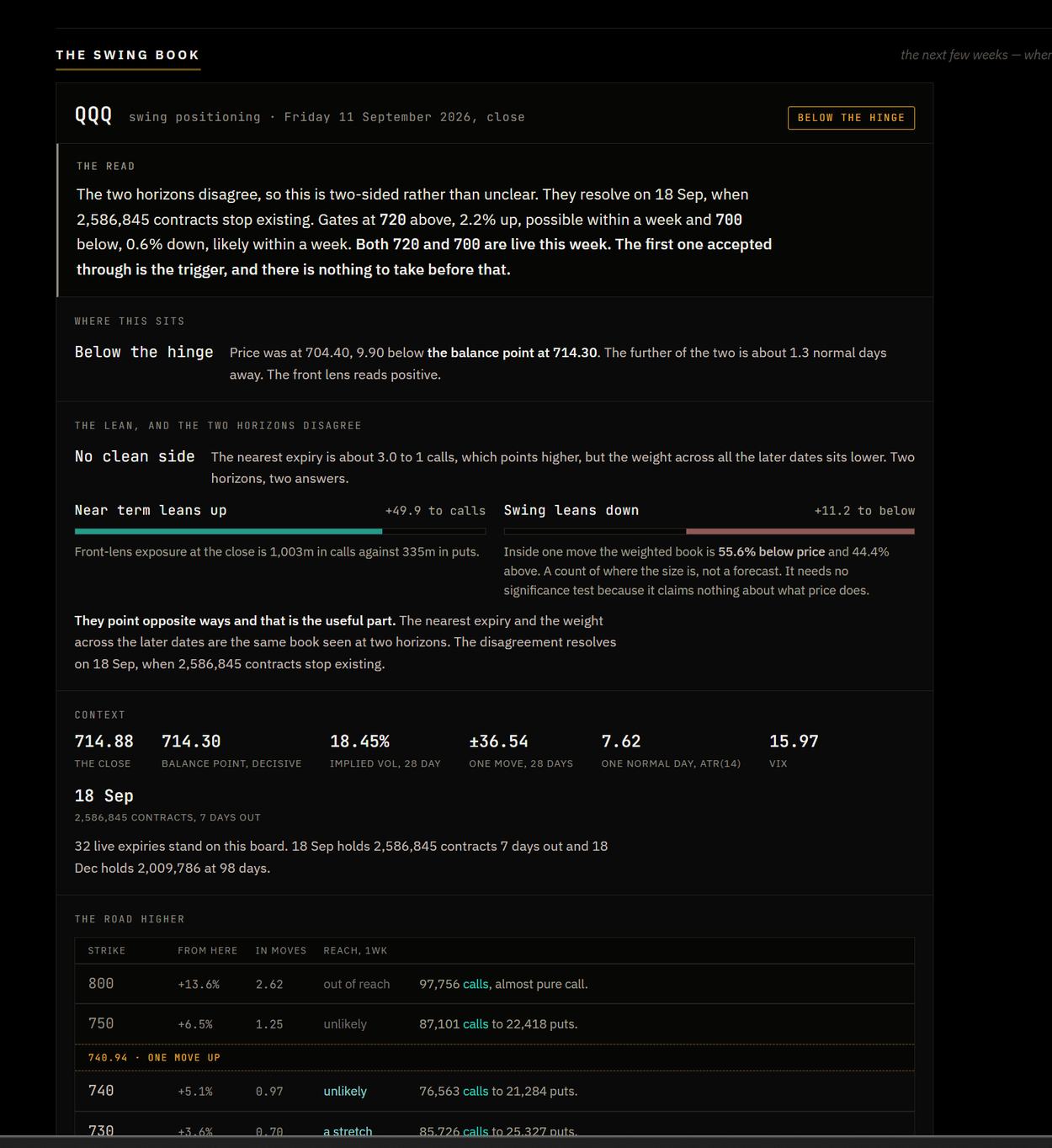
It opens on THE READ, which is the conclusion, and closes that paragraph on a bolded action line. Underneath: where price sits against the balance point, whether the near expiry and the weighted book point the same way, and the road higher and the road lower with each level's distance given in moves rather than percentages, because a 2% move means something different on QQQ than it does on an $18 stock.
The two gates it names are the two prices at which the read stops being the read. Whether price reaches either one is left open; what it says is that those are the levels where the book's own answer changes, and that the first one accepted through is the thing worth watching for.
Act I — YOUR BOOK
One line per position, across every symbol you hold. This is the answer to the only question that matters at the end of a day: is anything I am holding standing on ground that moved.
Here is a real book on a real evening. Three positions, all LEAPS.
SOFI 15 · 2028/06 · YOURS
Your 15 has lost contracts 3 days running (-6.1K). It is thinner than it was, and it is still thinning.
42.0K contracts here, 52% calls · 1st heaviest of 19 on that date
IREN 50 · 2028/01 · YOURS
Nothing has changed at your strike that bears on this position.
9.5K contracts here, 87% calls · 5th heaviest of 35 on that date · heavier above: 90 (12.0K)
NVDA 250 · 2027/06 · YOURS
Nothing has changed at your strike that bears on this position.
21.8K contracts here, 90% calls · 14th heaviest of 77 on that date · heavier above: 260 (36.2K)
Read the SOFI line first, because it is the only one asking for attention. The strike is being taken apart, three days in a row, and the sentence says it is still going. Note the shape of the claim: the crowd standing at your strike is walking away, a bit more each day. Selling, and where price goes next, are both yours.
Then read the sub-line under it, because it is the counterweight. 42.0K contracts, and it is still the heaviest strike of the nineteen on that date. So the thing thinning is also the biggest thing there. A member who read only the headline would panic; a member who read both lines knows this is a large level getting smaller rather than a small level disappearing.
IREN and NVDA are the state you should see most. Recorded, checked, and quiet. The page tells you the count underneath: 2 of 3 lines are quiet. That is the tool working, not the tool failing.
And the sub-lines still teach you something on a quiet night. NVDA 250 is 14th heaviest of 77 on that date, with 260 carrying 36.2K against your 21.8K. You are in a populated neighborhood, and the crowd is settled slightly above you. That is a fact about where you are standing, available at a glance, on an evening when nothing happened.
The colours mean one thing each. An amber edge is a strike about to lose most of itself at an expiry. A red edge is a strike being drained day after day. A bare edge is quiet. On a resting screen the whole column reads plain.
The lines you will see, and what each one means
| what it says | what it means |
|---|---|
| The structure at your 780 loses 62% of itself when 08/22 expires tomorrow | Most of what is parked at your strike sits in the expiry about to go. It names what is left nearest it. |
| Your 15 has lost contracts 3 days running | A streak. The level is being taken apart, and it is still going. |
| What sits at your 500 has grown 4 days running | The same, the other way. A thicker level than when you opened it. |
| Nothing has changed at your strike that bears on this position | Recorded, checked, quiet. The healthy resting state. |
| Nothing recorded at your strike yet. It fills in on its own | A different sentence entirely. Compass has no record here, and it stops short of calling that quiet. |
That last distinction is the one to teach. "Nothing changed" is a claim about the market. "Nothing recorded" is a statement about the record. A tool that said the first when it meant the second would be lying to you on your first night with a new ticker.
Act II — THE LEVEL
Your method finds the price, and that stays true by design: levels are discovered, and a tool that invented them would be drawing lines for comfort.
Type the price into What does positioning say about a level? and you get one row per expiration, up to fourteen dates. Then press Watch this level and it joins YOUR BOOK, so the tool minds it from then on.
A worked example: TSLA 320
Here is the real table, trimmed to the rows that carry the lesson.
The Strike column read 320 on every single row, so it is left out below to keep the table readable. That in itself is the first answer, and the first question explains why.
| Expiry | DTE | vs King | Open interest | King |
|---|---|---|---|---|
| 08/21 | 1 | 5% | puts 70% | 345 |
| 08/28 | 8 | 8% | puts 61% | 335 |
| 09/11 | 22 | 22% | puts 79% | 345 |
| 09/18 | 29 | 33% | puts 74% | 340 |
| 10/16 | 57 | 33% | puts 83% | 330 |
| 11/20 | 92 | 22% | puts 70% | 350 |
| 12/18 | 120 | 64% | puts 74% | 400 |
| 01/15 | 148 | 8% | puts 63% | 400 |
The Open interest column prints in full on screen as "put-heavy 70%"; it is abbreviated here to keep the page readable.
Four questions, in order. Teach it as a sequence and it becomes a habit.
1. Does my level exist as a strike? Every row came back Strike 320, so the line lands on a real listed strike rather than in a gap. If it had come back 322.5, the structure would be two and a half points from where you drew it, and that is worth knowing before you place an order.
2. Does it matter this week? No, and the table is blunt about it. Tomorrow's expiry has 320 at 5% of that board's King. Next Friday, 8%. For the front dates, 320 is a rounding error. Anyone leaning on this level as a day-trade line, on positioning grounds, is leaning on air.
3. So where does the level live? Read the vs King column downward. It climbs: 22, 33, 33, and then 64% on 18 December. On that board, 320 carries nearly two thirds the weight of the largest level on the whole expiration. The level is real. It lives on the later dates. That is exactly the kind of ground a swing entry wants underneath it, and exactly the kind a scalper should ignore.
4. Who is standing there? Put-heavy on every single date, 61% to 83%. 320 is where the crowd has parked its downside protection, consistently, on every horizon. That tells you what is there. Which way price goes is a separate question, and Compass leaves that call to you.
One more column worth a glance. King strike is above price on every date: 340 and 345 near, 330 to 360 through the autumn, and 400 on both December and January. The long money's anchor on this name sits at 400. You got that for free, just reading the last column down.
And ask it twice. The table answers in whichever lens is selected at the top of the app. Ask on GEX, then switch to VEX and ask again. Gamma is what dealers do when price moves; vanna is what they do when volatility moves. The same price can carry size on one lens and almost nothing on the other, and knowing which is real information about what kind of level you are looking at.
What stands between here and there
Underneath the table, Out of reach answers the other half of the entry question. On the same evening:
Above price: 350, 352.5, 355 carry size, and nothing reaches them while 345 holds.
It names the levels and gives their condition in the same breath, because naming size while leaving its reachability unsaid is the half that misleads. If your plan needs price to get to 355, this tells you what has to give first.
So the whole TSLA picture, in two sentences a member can repeat: above price there is a wall at 345 with more stacked behind it; below price there is a put shelf at 320 that only becomes a real positioning level from December out; and the long book anchors at 400.
Act III — WHAT CHANGED
The daily settled read. Open interest, day over day. This is where you learn what actually happened rather than what is merely sitting there.
Week two is one number from this act.
THE CLOCK
38% of everything parked near price expires tomorrow.
Read it as: thirty-eight percent of the structure you are looking at has a date on it, and after that date it is gone, along with the hedging that came with it.
It changes to past tense once the date has gone, so after the close on an expiry day it says expired today rather than expires today. A line telling you what is about to disappear switches tense the moment it has.
Why this one is second. It is the most actionable number on the page and the least ambiguous. A level you were planning to lean on may simply not exist next week, and that is worth knowing whether you day trade, swing trade, or write premium once a month.
THE ROLL, and THE LEVEL MOVED
Two lines that stop you reading a departure where there is only a change of address.
THE ROLL — "30 moved out to 03/20. It didn't leave." Contracts came off a strike for the front date and went back on at the same strike for a later one. The level is being carried forward rather than dying.
THE LEVEL MOVED. One strike empties across the window while a different strike fills. That is the shape a rerating makes: the money that stood at the old level now stands at the new one, and a bare drain read on its own would have called it the end of a thesis when it is closer to the opposite.
Both exist for the same reason. A number getting smaller becomes information only once you know where the size went: a later date, a higher strike, or out of the name entirely.
The far lens shows what is THERE, not what changed
Act III has two lenses and the line between them is sixty days.
Inside sixty days it draws change, day over day, because near-dated positioning turns over every week and a daily delta means something.
Past sixty days it draws what is standing rather than a delta, because a long-dated book moves in months, and a daily change on it would be rounding noise dressed up as a signal.
So a January level is a weekly check rather than a daily one. Widen the window control rather than staring at it every morning.
Week three: the Thursday check
Five minutes, Thursday evening. The window control is already on 1 day. Leave it. Read the headline, then two rows.
The headline, when a level moves:
780 moved out to 08/29. It didn't leave.
That is THE ROLL: contracts came off 780 for the front date and went back on at 780 for a later one. The level did not disappear, it moved out a week. THE ROLL only appears when there is one, and most Thursdays it stays off the card. That is the tool naming only what actually happened.
WATCH is the row that is always there. Last row on the card, and it tells you what to reread and when.
And the row worth more than either, when it appears:
BIGGEST PULL — 4.6K contracts left 300 (09/18).
The cap at 300 is thinner than it was — closer to what the Map calls thin.
watch: If a plan of yours uses 300 as support or a target, look again before you trust it.
For somebody holding into next month, that is the most useful line on the card.
Most traders keep last week's lines on this week's board for days after they stopped meaning anything. Five minutes on Thursday is how you stop being one of them, and it requires no prediction at all.
Act IV — THE LONG BOOK
The monthly read: the character of the name you are trading. Four chips and a headline.
The long book anchors at 350.
THE ANCHOR 350 · THE MIX 61% calls · THE REACH 17 mo · THE RECORD 9 days
Read this over months, not days. Long books change shape slowly, and a daily delta on one would be inventing signal out of rounding. THE RECORD tells you how many days stand behind what you are looking at, so you always know how much to trust it.
Skip this act entirely until you have a quarter of history to compare against.
Act V — THE HYPOTHETICAL
One board, one trade, said out loud. This is the newest act, and the reason it exists is simple: a swing board leaves time for a thesis, and a tool that reads the board all evening and then refuses to say what it sees is being coy rather than careful.
This board describes one trade.
SOFI 17.91. The heaviest long-dated structure stands at 20 for January, 148 days out, 12% above price, and 77% of the contracts standing there are calls...
It comes in three shapes, chosen by what the structure actually is, never by which side of price it happens to sit on. Structure above price with calls standing there is a destination: the full walkthrough — the month to buy, the strikes near the money, the size discipline, and three exits decided before entry. Structure below price, whatever the mix, is a floor, not a trip: ownership and insurance brace the level, the act explains which kind yours is, and it says plainly that a put toward the crowd's own floor is the map read upside down. Puts standing above price are a lid. Most names, most weeks, are floors — that is what a long book looks like after a rally, and the act treats it as the teaching moment it is.
It reads in three parts
Worth knowing, because it changes where you look.
One, the argument — prose. What the structure is, why it means what it means, and the mechanics underneath it, ending on a single line of conclusion.
Two, the play — the same facts as labelled rows. What it is for, the play itself, the trade you would get backwards, what kills it, and what to watch. Seven things a member has to find, findable at a glance instead of buried in the fourth sentence of the fifth paragraph.
Three, before you act — under its own quiet label, the two things that are genuinely "and also": the vanna check to run, and the same idea expressed in shares.
Before this the trade sat in the middle of the prose with more argument running underneath it, so the thing you actually needed was the hardest thing to find. The rows are the landing now, rather than a rest stop.
Your seat
Above the act there is a row: I'm long · I'm short · Looking long · Looking short.
The board does not change. The reading does. Somebody already holding the name and somebody deciding whether to buy it are asking different questions of the same facts, and the page used to be written for one of them.
It defaults to no seat, and no seat is exactly what was there before. Leave it alone and the page reads as it always did.
What to do from any seat stays yours — and that is the point rather than a limitation. A single reading always drifts toward sounding like a call, because a single reading has a direction. Four honest readings of one board hold each other in check. The structure is what keeps the promise, rather than the wording.
The rules it can never break
Every rendering is labeled hypothetical, every sentence stays conditional, and only single calls, single puts, and shares ever appear: spreads, premium writing and margin all stay out. The sizing line, money that can go to zero entirely, prints in every seat, always. And direction is always yours rather than the board's. The act names the month, the neighborhood, the exit area, and the size discipline. Whether the name deserves the thesis, and which day earns the entry, stays yours.
What kills it, and what only looks like it
The invalidation row used to say a level draining meant the thesis was dead. That was wrong, and it was wrong in a way that would have cost somebody a good position.
A strike empties for four different reasons and only one of them is bad:
- The holders left the name, and the protection went with them. That is the end of it.
- The name rerated and the level moved up. The old strike is far out of the money and useless as insurance, so it is closed and rewritten higher. Somebody whose position doubled keeps insuring it — at the new price. The floor did not collapse. It moved. On a fast name this is the expected shape rather than the exception.
- It rolled out to a later date, same strike. Act III already says "it didn't leave."
- It expired. The calendar did that, and it carries no signal.
So the question runs past "did it drain." It is "did it drain, and did nothing appear anywhere else." Draining into a higher strike is close to the opposite signal: the people who own the name have re-marked where they think the floor is, upward, with money.
The row also speaks at the right pace now. A level 144 days out is checked week to week rather than day to day, because Act III's far lens deliberately leaves the daily change off a book that moves in months — and telling you to watch daily a number the next room draws weekly was the app contradicting itself one screen apart.
Two paragraphs inside it are worth knowing in advance. The vanna cross-check reads your own recorded VEX looks: when the vanna board's far King stands on the same strike as the anchor, the act says so and cites the day the look was recorded; when it disagrees, it names the second level and what each one is for; when nobody has looked, it teaches the thirty-second check and reads the look automatically the next time. And when a second pile stands farther out at half the anchor's weight or better, the second act names it — same map, longer clock, for the trader who prefers owning years rather than months.
Read it even in week one — it costs two minutes and it is the page's best teacher. Just remember what it is: a labeled scenario from this board only, and it changes when the board does.
Act VI — THE CONDITIONS
Glanced rather than studied. Four things, and only one of them ever needs action.
The weekend, which appears on Fridays only:
After today's close this book crosses two non-trading days before it can be traded again. Time decay does not pause for them.
Pure calendar arithmetic, known in advance. What the decay does to your position is left unsaid, because saying it would be a claim we have yet to measure.
The cycle tells you where you are in the monthly expiry rhythm. Skew is one number about what the options market is paying up for; its own caption admits the level says little without day-over-day tracking, so treat it as a glance. Vanna below spot names places beneath price where dealer hedging would change character if the market got there, and if one of your watched levels is on that table, the page says so.
Act VII — THE INCOME BOOK
The closing act, on its own on purpose: every other act reads the same board in sequence, and this one answers a different question for a different day. It is the strike-selection view for writing against the crowd — and if the entry you are planning is a sold put, remember that getting assigned at 285 is an entry rather than an exit, so this page is part of the entry too.
Pick a date between about one week and four months out. It draws the seven strikes above price and the seven below.
On 09/18, the crowd sits at 350 above and 320 below.
Overhead, 350 carries the most contracts (18.4K, +7.2% from price) — that is the busiest strike to write a call at on this date. Underneath, 320 carries the most (14.1K, -1.9%) — the busiest strike to write a put at. Teal marks the heaviest on each side.
Covered calls look up. Cash-secured puts look down. It is the same question both ways: does the strike I am writing have company.
A strike with company sits inside structure. A bare strike sits in thin air. Both are legitimate choices, and this tells you which one you are making. Picking the strike stays yours.
One caution the panel prints itself: if the front expiry lands before your date, check THE CLOCK in act III first. Premium sold against a board that is about to expire is premium sold against structure with a date on it.
The week, for someone with a job
Every one of these happens away from the screen, outside market hours. That is the point.
| when | how long | what you do |
|---|---|---|
| Sunday evening or Monday before the open | 10 min | YOUR BOOK. Read down the lines. Usually you conclude the ground held. |
| Thursday evening | 5 min | THE CLOCK, THE ROLL if it fired, and WATCH. Know what survives the weekend. |
| Friday after the close, or Monday morning | 10 min | After a big expiry, reread the board before trusting any level on it. |
| Before you enter something new | 5 min | Your price through THE LEVEL, on both lenses. Then Out of reach. |
| When a far board tempts you | 5 min | THE HYPOTHETICAL. The trade the board describes, and the discipline that rides with it. |
| Before you write premium | 5 min | THE INCOME BOOK. Where the crowd already sits on that date, and does it expire first. |
Thirty-five minutes in a normal week, and most of it optional.
Your first night will look thin, and it should
The near board needs two recorded days to show change, and on your first evening it has one. That is the record filling in.
Act I works immediately: it reads your book and tells you honestly where the record is still filling in. Act II works immediately, because the level table and Out of reach read the live chain rather than the record. The rest arrives over the following days on its own.
Four things that stay outside it
- Whether a level will hold. Whether a level works turned out to be a property of the board rather than of the level. The Regime Is the Edge is the document for that.
- Who is on the other side. Open interest records that contracts exist, and stays silent about who owns them.
- Your entry. Your method finds those. Every example above describes a price you brought.
- Which way price goes.
What it does instead is narrower and, for something you intend to hold, more useful: it tells you whether the ground under your position is being built or taken apart, and it tells you when the map is about to change.
One honest caution
"Does a strike being built mean it will hold?"
That is still to be measured. It is the obvious question, it is the first study this layer will run, and until it runs, a strike being built is a description of what people did rather than a statement about what price will do.
Anyone telling you otherwise is guessing with confidence.
If it says the same thing it said last week, that is the tool working. The weeks it does change are the ones you want to have been watching for.
This guide is the product's own, published as members read it. All guides · The Legend